I was meandering through the tumult that is Jaipur when I spotted a young girl of perhaps five walking around, not miserable, but also not playful. As I usually do when I see children who are apparently alone, I let my attention linger long enough to make sure she was okay. She didn’t seem distressed, but, I observed, neither did she seem to have any adults looking after her. A street girl, apparently. Homeless.
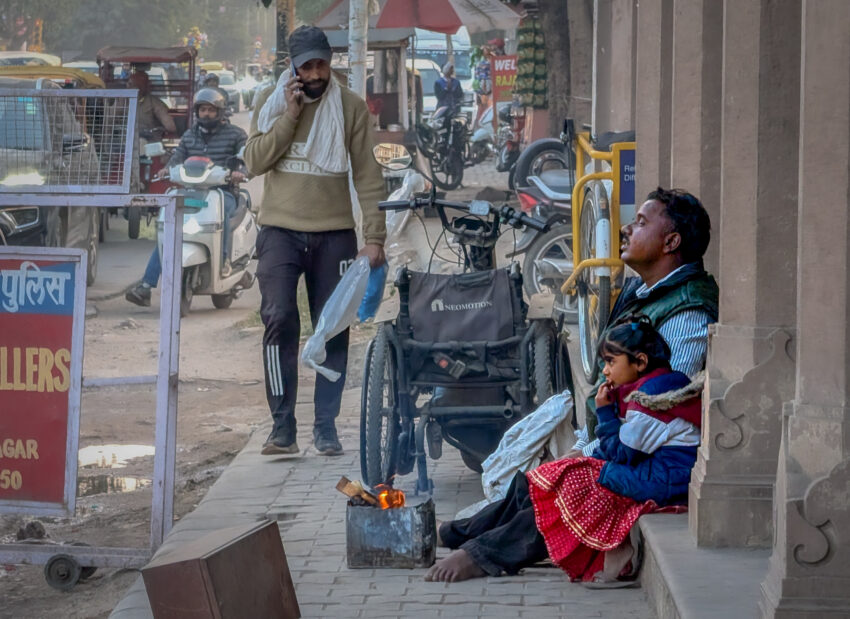
She wore a winter jacket over a dress and jeans, and no shoes. Unlike the professional beggars outside my hotel — who practically accost me — she paid me no attention as she walked right by me, and, again unlike the professional beggars, she didn’t ask for money.
As she walked away, I wondered if I should offer to help. But she really didn’t seem to be in trouble. She left.
Eventually she returned and made her way to a man and a woman warming themselves by an improvised fire on the sidewalk, presumably her parents. They too were dressed for cold weather.
It was 55 degrees Fahrenheit out (15 Celsius), so they were not in mortal danger from the cold, even if the temperature kept dropping, but neither would their meager fire keep them warm. And what about food?
What was her story? What was theirs?
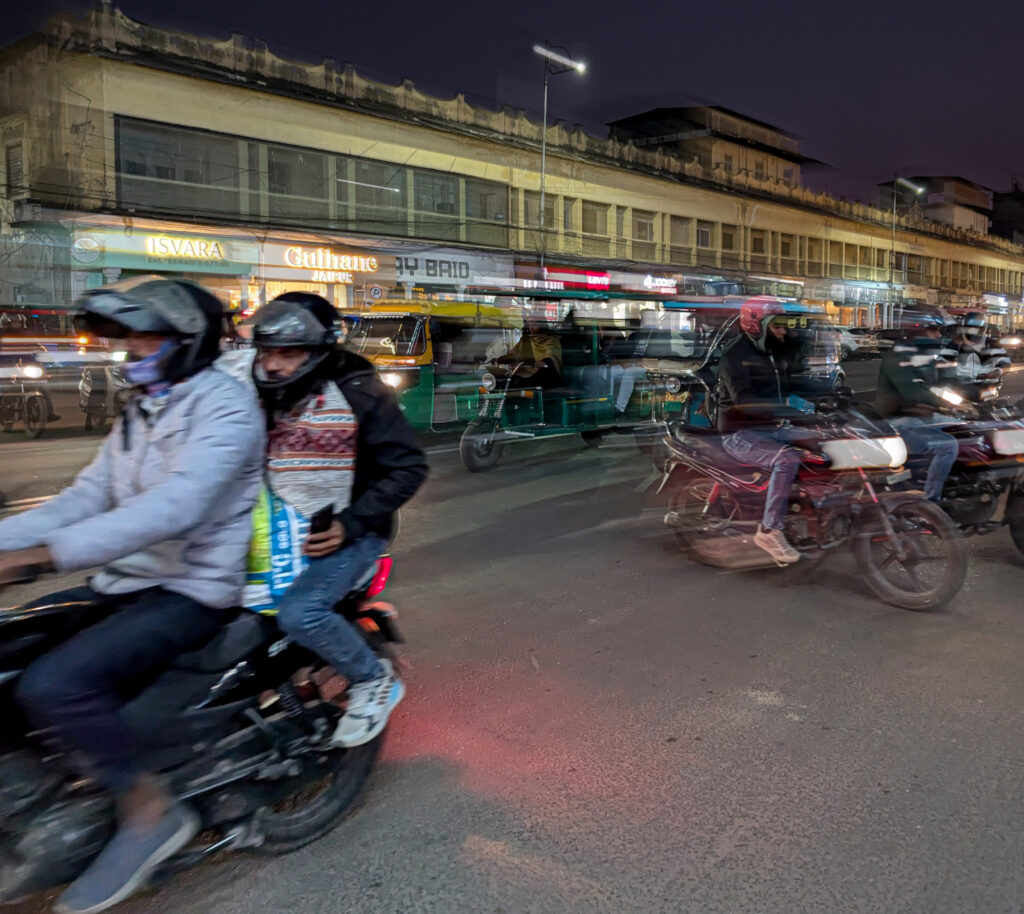
I wanted to find out, but I don’t speak the local language, and they seemed unlikely to know any English. However, I thought, with so many people walking by I would eventually find someone I could ask to translate — a student, maybe.
My other dilemma was whether to give them some money. I wanted to, of course, particularly because my American dollar goes so incredibly far here in India. People can live on a dollar or two a day, even in the big city.
But meddling in foreign cultures is tricky. I remembered stories of well-intentioned outsiders whose efforts backfired. The thought also occurred to me that if I gave the family too much money, they might be mugged for it. And what if I created a wealth gap that caused rifts in their impoverished community? I waited indecisively, watching from afar, and scanning the myriad passersby for a potential translator.
I saw the girl try to cuddle against her mother, and my heart shattered as the mother struck her daughter — not hard, but more than a push. The girl hit back.
I wasn’t judging. What do I know about raising children on the street? The few homeless people I’ve spoken to have been in New York City, many of them mentally ill, and even if not, rarely mentally well. And for that matter, hitting children is acceptable in many cultures. But I suddenly doubted that money would even help. Would it go to the girl? Would the family use it wisely?
The world is filled with misery, I thought, and with gut-wrenching sorrow, and with inequality, and with the tragic failure of humankind to care for one another. But mostly with misery.
Crestfallen, stunned, and defeated, I stood in a daze. Everywhere I looked I saw unhappiness and anguish. I was no longer eager to explore. I barely had the energy to return to my hotel.
The girl wandered off alone. Then the mother did too. I had lost my chance to talk to them, lost my chance to help. Did it matter? The family was hardly unusual. I would pass hundreds of people in similar situations on the 40-minute walk back to my five-star hotel, where I would spend $100 for a luxurious night’s sleep and whatever food I desired.
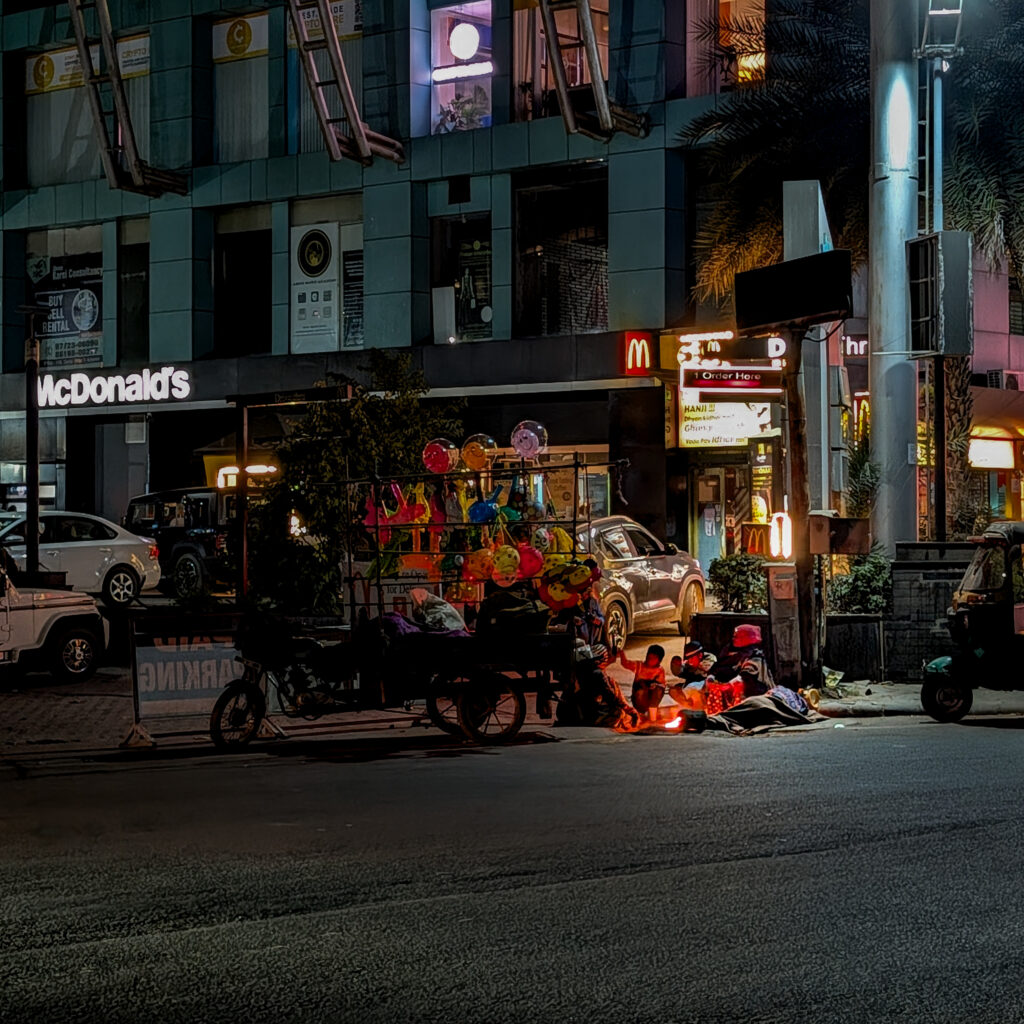

I spent several minutes observing the variety of people around me, wondering by what rights this girl had started with so little and others with so much.
Then I saw the mother again. She had collected a rack of balloons of some sort, presumably to sell. The sun had set by now. Perhaps balloons sell better by night?
And the girl was with her. This was my opportunity. I made a decision. I walked over with 500 rupees in hand, about $5.
I smiled and handed the bill to the mother, gesturing that it was for her daughter. She smiled back. And she handed the money to her daughter, who smiled broadly.
In English I asked their names, but they didn’t understand. I pointed to myself and gave them mine, and then pointed to them. This time they got it. I couldn’t understand the mother’s name. But the girl’s name, apparently, was Shanti. Peace.
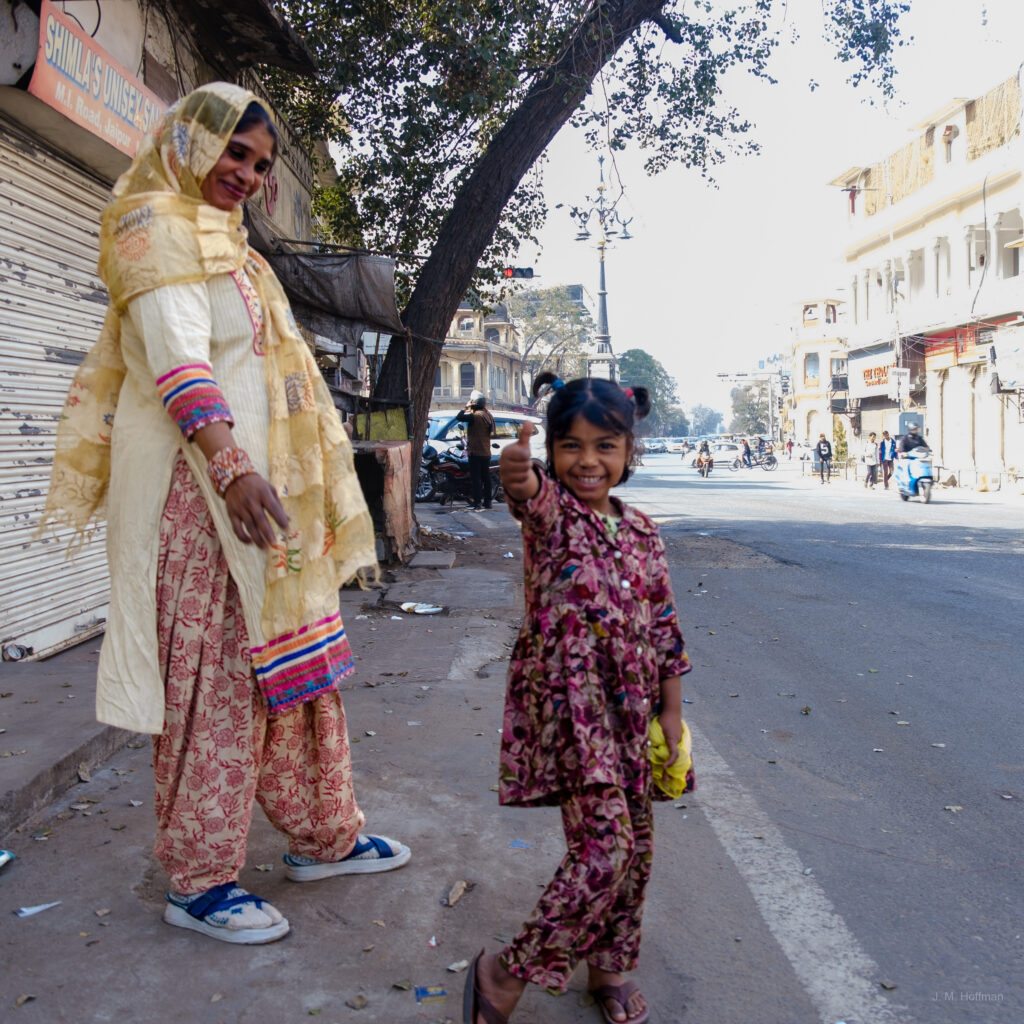
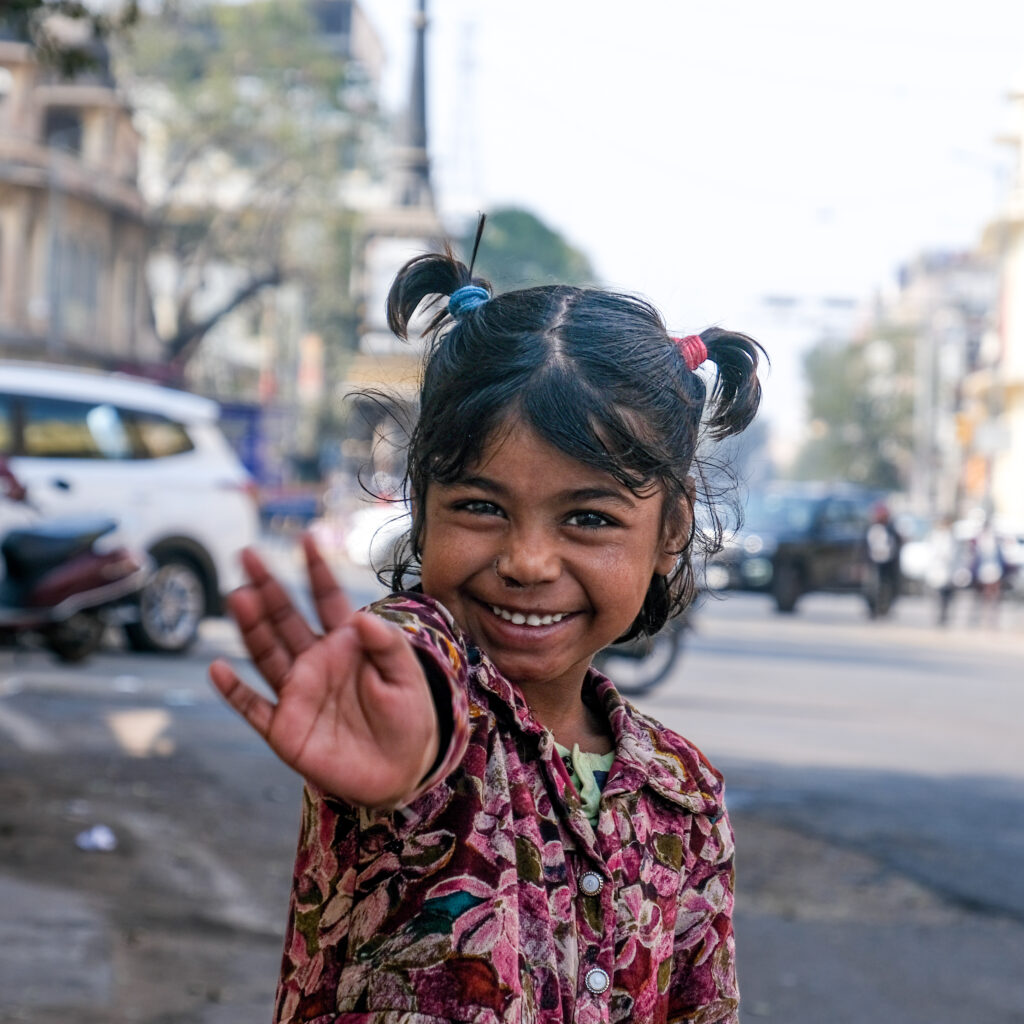
They didn’t object to a photo. Shanti was all giggles and joy. She and I parted with a high five and a thumbs up and more smiles.
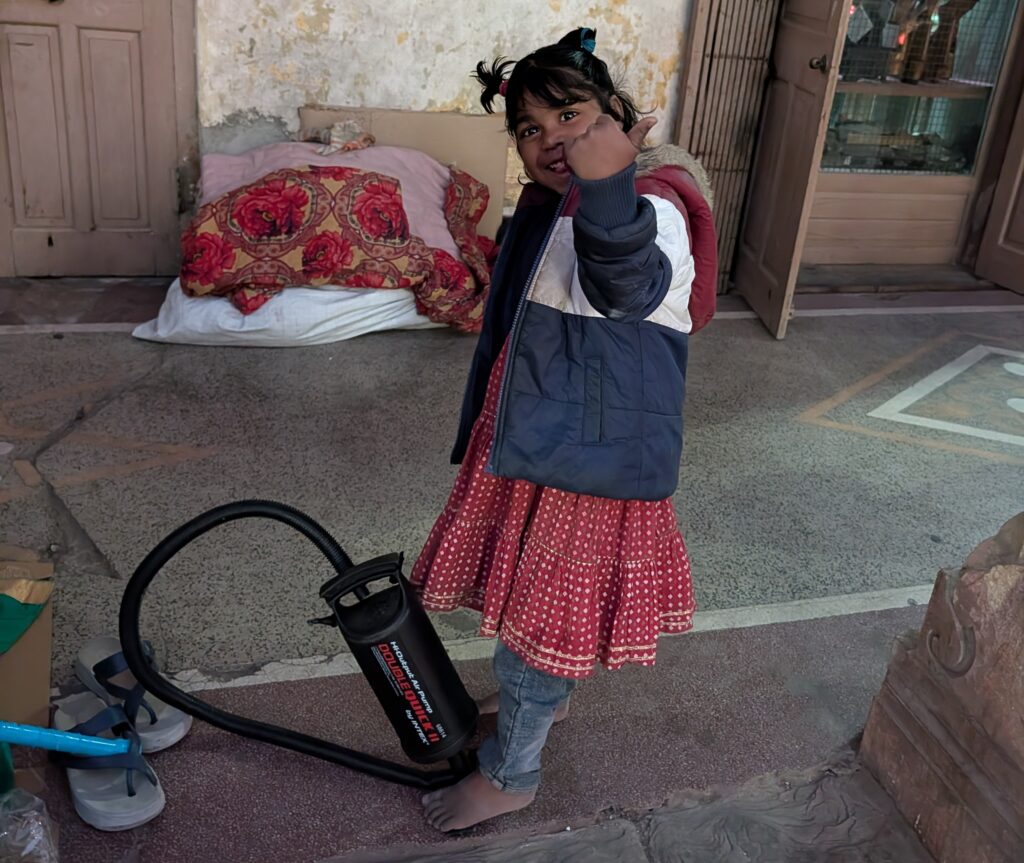
This unshod homeless girl wasn’t at all what I thought. She was fine, happily going about her day in circumstances that in New York would be called crippling poverty.
I was emotionally drained but elated, having witnessed, I felt, the downfall and redemption of humanity itself as embodied in this innocent child — even though her drama wasn’t even a tempest in a teapot. There was no storm, merely an imagined crisis born of a gross mismatch between our diverse experiences, and resolved by our shared humanity.
Have a good life, Shanti.
For me, this episode is particularly powerful because it forces me to confront a haunting question: How much is enough?
That is, when should we demand more, for ourselves and others? And when should we be satisfied with what we, or they, have?
Is Shanti satisfied with what she has, living an impoverished life on the street? Apparently. Is that a good thing? Or should she (or we) demand more for her life?
Two extreme answers to the general question are obvious. On one side (in accord with some Eastern philosphies), we should always be happy with whatever we have, no matter how little. And on the other (corresponding to more Western thought), more is always better.
Proponents of the first extreme might note that I don’t consider myself “palace-less,” even though I don’t live in a palace. In this regard, I don’t define my life by what I lack, and I don’t think my lack of a palace in any way diminishes my life. Maybe we similarly shouldn’t call Shanti “homeless.” Maybe she doesn’t define her life by the home she lacks, and doesn’t think that her conditions diminish her life.
Proponents of the second extreme might note that — whether she realizes it or not — her street life prevents her from reaching her potential. Similarly, maybe my satisfaction with a mere house likewise limits me. Maybe I should strive for more.
Both of these simplistic approaches mask what I think are the real nuances, among them: Is there a point beneath which it’s impossible to be happy? Is happiness the only metric of success for a person or for a society? What is the role of expectations in shaping our opinion of our own lives and the lives of others? And to what degree are fairness and equity desirable?
More immediately, is there something we can learn in the United States from this Indian story?
For myriad reasons, it’s difficult to compare India directly to the U.S., particularly when it comes to living on the street. Homelessness in, say, New York, entails not just poverty but also physical danger from violence and mortal danger from the elements, whereas in India the streets are by and large safe (I’m told), and the weather is seldom deadly. And the homeless in India have better access to medical care. Furthermore, street life in India somehow includes a robust and supporive social community, unlike in the U.S. And for that matter, the U.S. has enough money to house everyone, while India apparently does not. (On average, one American has as much money as 25 Indians.) So even to the extent that the Indian approach is a success, we still may not be able to import it to the U.S.
But as I write this, two macro trends seem to be headed for a colossal collision. India is trying to become more Western, while in the West, people are seeking life advice from Eastern wisdom.
It’s hard not to think that both systems have something fundamental to teach us.